Spray drying is one of the most energy-intensive steps in dairy and food processing. Whether a plant is producing Whey Protein Concentrate (WPC), Whey Protein Isolate (WPI), Milk Protein Concentrate (MPC), Milk Protein Isolate (MPI), or other protein ingredients, the dryer consumes a large amount of thermal energy simply to evaporate water.
That means every pound of water removed upstream matters. Membrane systems already play a major role in reducing dryer load by concentrating product before thermal drying begins. But the performance of those membrane systems has a direct impact on how much energy the dryer ultimately consumes.
When concentration systems can consistently reach higher solids, less water enters the dryer. Less water entering the dryer means less evaporation required, lower energy demand, and lower operating costs.
The challenge is that conventional membranes often struggle to maintain performance as solids increase.
Higher Solids Become More Difficult as Fouling Builds
In whey and milk protein concentration, membrane performance is heavily influenced by fouling and gel layer formation. As proteins, fats, and organics accumulate on conventional membrane surfaces, sustainable operating flux declines and systems become harder to run efficiently at elevated solids.
Eventually, plants compensate by cleaning more often, slowing production, or operating at lower concentrations.
That downstream impact is easy to overlook.
If membranes cannot reliably push concentration higher upstream, the spray dryer has to remove more water thermally downstream. The energy penalty shows up there instead.
ZwitterCo Evolution® membranes were developed specifically for streams affected by organics. The patented zwitterionic chemistry forms an extremely hydrophilic surface that actively repels organic foulants. By resisting organic fouling and minimizing gel layer formation, Evolution membranes maintain higher sustainable operating flux and recover more easily during cleaning.
In field demonstrations, Evolution SF membranes have shown higher operating flux than conventional PES UF membranes during whey protein processing with no noted difference in permeate at retentate solids of 28–29%. Operation with sweet whey concentration to WPC35 also demonstrated favorable flux performance with Evolution SF and PCM membranes at high solids conditions.
Those performance improvements directly affect dryer economics.
A Small Increase in Solids Creates Large Energy Savings
Even modest increases in concentrate solids entering the dryer can create meaningful cost reductions.
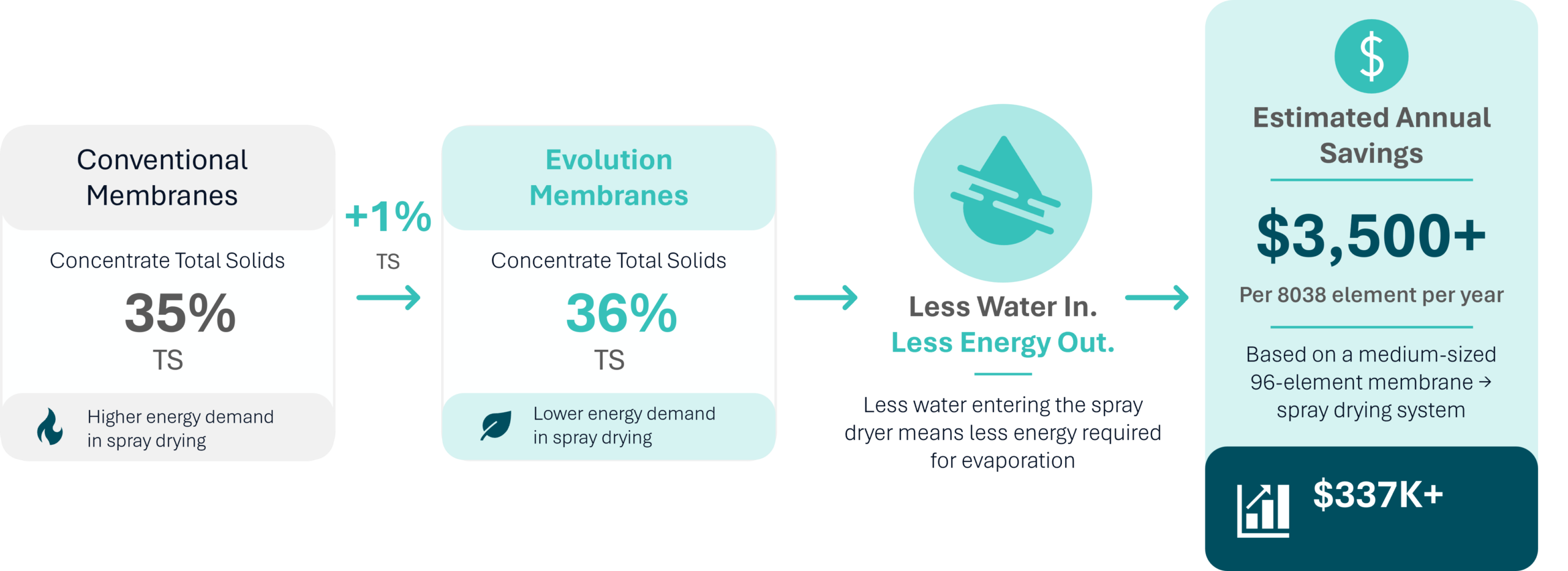
ZwitterCo economic modeling shows that increasing concentrate solids by just 1% can save more than $3,500 annually per membrane element in spray drying energy costs. In a medium-sized 96-element system, that can represent more than $337,000 per year in savings.
The reason is straightforward: less water entering the dryer means less energy required for evaporation. For processors operating large drying systems continuously, those savings compound quickly over time. Higher concentration upstream can also improve dryer throughput, reduce bottlenecks, and create more operational flexibility during peak production periods.
Cleaning Programs Also Impact Energy Usage
Drying is not the only place where membrane systems consume energy.
Cleaning programs themselves require heating, pumping, recirculation, flushing, chemicals, and water. In many dairy systems, enzyme washes are among the longest and most expensive parts of the cleaning program. Every cleaning step uses chemicals, make-up water, wastewater treatment capacity, and energy for heating and recirculation.
Evolution membranes help reduce that burden through simpler cleaning programs and improved cleanability.
Multiple dairy RO installations have demonstrated the ability to eliminate enzyme cleaning steps entirely, which most often represents the most expensive part of a cleaning program. Shorter cleaning programs also return systems to production faster.
In one dairy effluent polishing installation, Evolution RO membranes reduced overall cleaning costs by 57%, reduced chemical usage by 65%, and reduced cleaning-related water usage by 36% over long-term operation.
Membrane Performance and Dryer Economics Are Connected
Membranes and spray dryers are often discussed as separate parts of the process. In reality, they are tightly linked.
Higher sustainable membrane flux supports higher concentration. Higher concentration reduces thermal load on the dryer. Simpler cleaning programs reduce energy demand during cleaning while returning systems to production faster. Small improvements upstream create measurable impacts downstream.
As processors continue looking for ways to reduce operating costs and energy demand without major system redesigns, membrane performance is becoming an increasingly important part of the conversation.
Contact ZwitterCo to learn how Evolution membranes can reduce drying energy demand and improve productivity.