ZwitterCo Unfiltered is back with Episode 2, continuing the series focused on real-world membrane behavior in food, dairy, biotech processing. Hosted by Jon Goodman (VP of Food Processing & Specialties, ZwitterCo) and Scott Brown (Senior Business Development Manager, ZwitterCo), this episode tackles customer questions head-on before diving deep into a topic most processors don’t talk about enough: membrane element autopsies.
Listen to episode 2 here.

Customer question #1: Do I need to change my system to run ZwitterCo elements?
The short answer: no system redesign required.
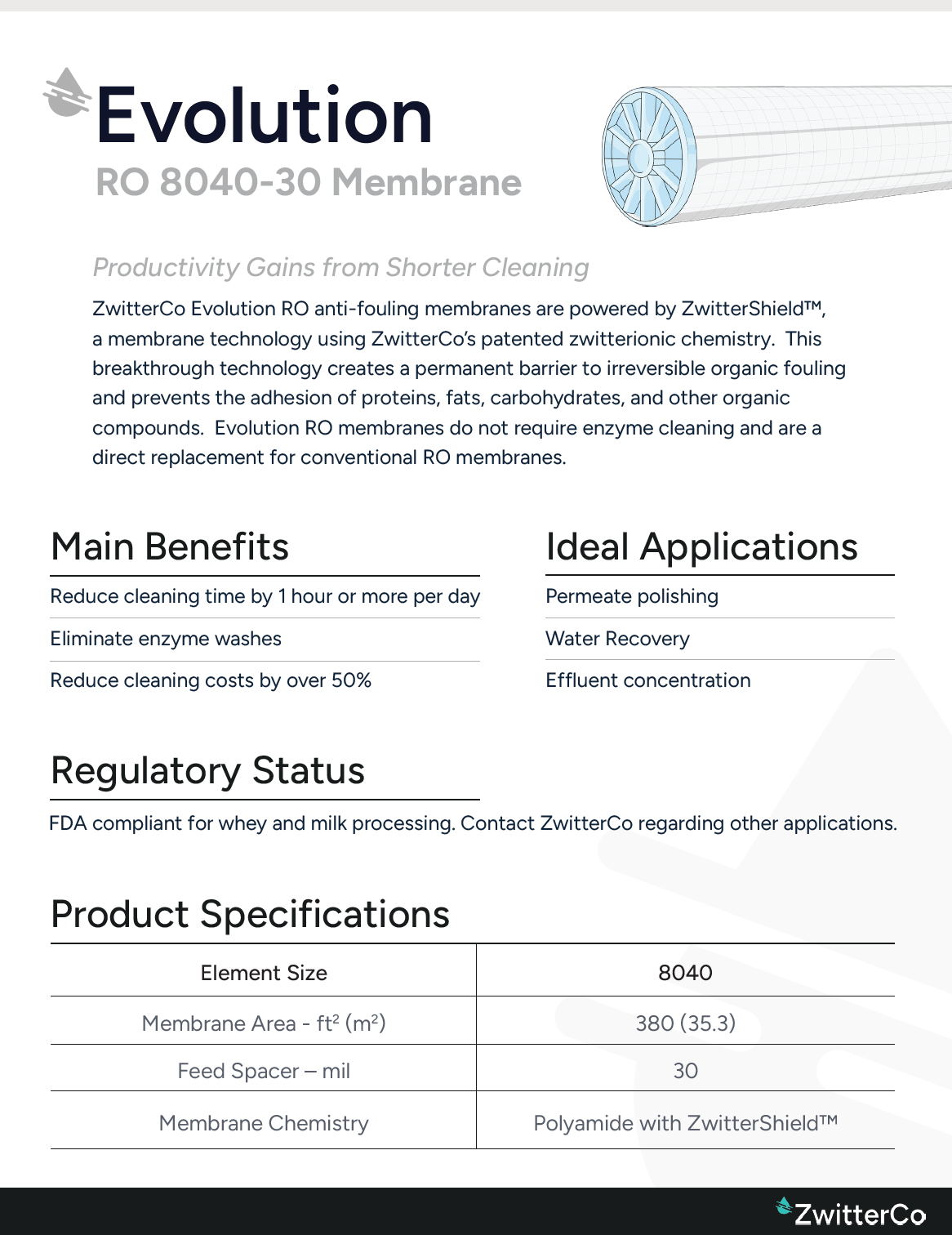
Jon and Scott explain that ZwitterCo elements are designed as direct replacements for conventional membranes. In most cases, customers install them and keep running. The one adjustment that sometimes comes up isn’t adding equipment – it’s actually removing membrane area.
Because ZwitterCo elements often run at significantly higher operating flux (frequently cited as 50–100% higher in some applications), certain systems end up producing more flow than originally designed for. In those cases, operators may need to take elements offline to stay within hydraulic limits.
Jon adds some nuance from testing and early field data: gains depend on total solids. At lower solids, where conventional membranes already operate near their ceiling, increases might be closer to 10–20%. At higher solids, the operating-flux advantage becomes much more pronounced. As more field data comes in, that picture continues to sharpen.
Customer question #2: Do you offer special-sized elements?
Yes – and more than most people realize.
Scott walks through the standard sanitary sizes ZwitterCo offers, including 3838, 6338, 6438, 7838, and 8038 elements. But the conversation gets interesting when they talk about non-standard formats.
ZwitterCo also supports:
- 2538 elements, commonly used for biotech testing
- 1812 elements for benchtop proof-of-concept work
- A wide range of feed spacer options (30, 46, 65, and 80 mil, depending on size)
The point isn’t just availability – it’s flexibility. Jon encourages customers to talk directly with ZwitterCo’s technical team to match element design to real process needs.
The main event: What is an element autopsy – and why does it matter?
From there, the episode shifts into its core topic: element autopsies.
Scott approaches it from the plant perspective. Any time membranes were changed, he made a habit of cutting a few open. Not just for compliance reasons (USDA inspections), but to understand what was actually happening inside the element. Over the years, he’s found everything from gasket fragments to sand – clear indicators that upstream protection had failed.
Jon adds the supplier-side view. From a membrane manufacturer’s standpoint, autopsies fall into two buckets:
- Proactive autopsies during manufacturing, used to validate designs, glue lines, and assembly quality
- Failure analysis, when customers report low flux, high passage, or unexpected performance loss
In both cases, the goal is the same: solve the mystery.
What they actually look for when cutting an element open
Scott describes unrolling entire elements to inspect every leaf – especially the membrane fold near the permeate tube. That area is often the most vulnerable, particularly in food applications where aggressive cleaning programs are common.
They look for:
- Product trapped in hard-to-clean areas
- Evidence of overcleaning (brittle membranes, cracks, weakened backing material)
- Wrinkles caused by manufacturing or operational stress
- Improper feed spacer insertion
- Signs of hydraulic shock or failed soft starts
Jon shares a story from the 1990s where repeated high-pH midday washes weakened the polyester backing at the membrane crease. Combined with pressure hammer from faulty soft starts, membranes literally split open. The “test” back then was simple: if you could push your finger through the membrane, it had been overcleaned.
The bigger takeaway
The episode lands on a point every processor recognizes: systems are always pushed harder than they were designed. No matter how much membrane area you install, someone will eventually run it at 110%.
That’s why understanding failure modes – and learning from autopsies – matters. They reveal whether performance loss comes from fouling, overcleaning, poor upstream separation, or mechanical stress. And in many cases, the fix isn’t new equipment – it’s better operating discipline and smarter cleaning programs.
Jon closes with an open offer: if you’ve never seen an element autopsy, ZwitterCo’s team is willing to come onsite, cut elements open with you, and walk through what they see – no mystery, no guessing.
Want to take us up on the offer? Contact us today.