In a recent blog, we discussed how landfill leachate treatment is becoming increasingly constrained by organic fouling rather than salinity or pressure limitations. This article builds on that foundation with a deeper technical dive into why those constraints are emerging and how changing source conditions and regulatory expectations are pushing conventional treatment designs beyond their practical operating limits.
Historically, landfill leachate treatment systems were designed based on landfill age, waste composition, and relatively stable assumptions regarding leachate chemistry. System performance was primarily governed by conductivity, scaling potential, and hydraulic loading, and when these parameters were controlled, downstream membrane processes generally operated within their design operating limits. These assumptions are increasingly invalid, as changes in rainfall intensity, flooding events, and leachate flow conditions, combined with tightening regulatory requirements, are driving leachate compositions beyond historical design conditions and exposing the practical limits of conventional treatment systems.
Climate Change Is Altering Leachate Chemistry at the Source
Changes in precipitation intensity and frequency are altering leachate generation mechanisms at landfill sites. Increased occurrence of high-intensity rainfall events, flooding, and extended wet periods is resulting in higher transient leachate flow rates and greater variability in leachate composition across both Europe and the United States.
Under flood and high-flow conditions, leachate formation is no longer governed by slow percolation through the waste mass. Instead, rapid infiltration and preferential flow paths dominate, reducing contact time and bypassing zones that previously provided attenuation through adsorption, biodegradation, or dilution. This hydraulic behavior mobilizes soluble and colloidal constituents that would otherwise remain retained within the landfill matrix.
The resulting leachate is not simply diluted. Field observations increasingly show elevated and highly variable organic loading, including increased COD, TOC, surfactants, oil and grease, and fine colloidal organics. These changes frequently occur without corresponding increases in conductivity, as conductivity may remain stable or decrease due to dilution while organic fouling potential increases.
From a membrane treatment perspective, this represents a shift in the primary design constraint. Modern landfill leachate is increasingly limited by organic fouling propensity rather than salinity, with feedwater characteristics driven by event-based hydraulic loading rather than steady-state seasonal conditions.
Tightening Regulatory Requirements for Landfill Leachate Treatment
Regulatory requirements for landfill leachate discharge and reuse in both Europe and the United States are increasingly driven by parameters associated with organic load, nitrogen species, and effluent consistency. As a result, treatment system performance is being evaluated against tighter and more persistent compliance criteria that directly impact membrane operation.
Permits increasingly specify limits for COD, TOC, ammonia, total nitrogen, color, and effluent stability, along with growing regulatory scrutiny of persistent and emerging contaminants. In landfill leachate applications, this includes compounds such as PFAS and AOX, which are commonly detected at low concentrations but are subject to heightened regulatory attention due to their persistence and environmental impact.
These regulatory expectations place increased emphasis on long-term, stable treatment performance rather than short-duration compliance. Systems that rely on frequent chemical cleaning, increasingly aggressive CIP protocols, or shortened membrane replacement intervals to maintain permit limits face rising technical and economic risk. Under current permitting frameworks, treatment approaches that cannot sustain performance over extended operating periods are becoming progressively less viable.
Addressing Organic Fouling Constraints in Landfill Leachate Treatment
Conventional RO systems used for landfill leachate were historically designed around bulk water quality parameters and relatively stable operating conditions. Under modern leachate compositions, system performance is increasingly constrained by organic fouling rather than pressure or flux limits.
Elevated and variable concentrations of COD, TOC, surfactants, oil and grease, and fine colloidal organics drive rapid permeability loss, cleaning intervals dictated by flux decline, incomplete recovery after CIP, and shortened membrane service life. In many installations, system availability is limited by cleaning frequency and membrane durability, not hydraulic capacity.
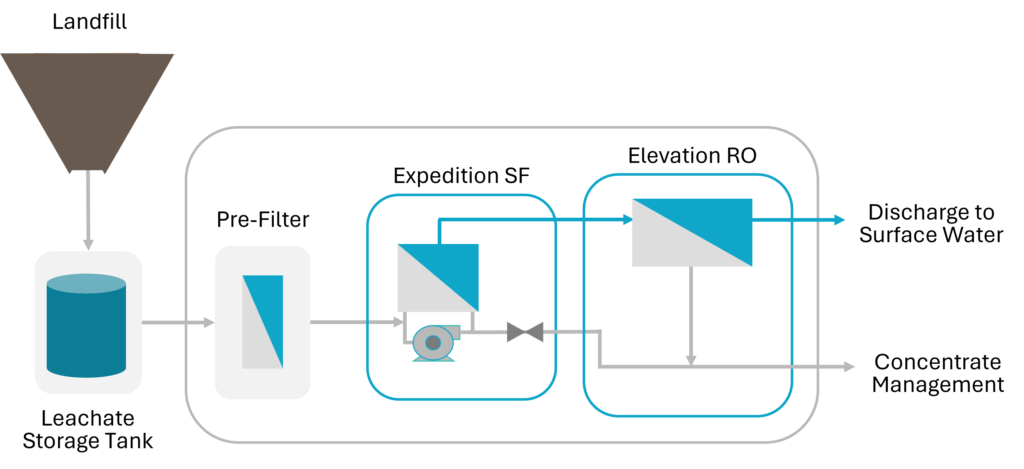
Under these constraints, an effective treatment configuration requires separation of organic load control from RO polishing. Upstream pretreatment uses ZwitterCo Expedition Superfiltration to remove suspended solids, fine colloids, and high molecular weight organics while operating reliably with leachate containing up to 5% oil and grease. This stabilizes RO feedwater quality and decouples hydraulic variability from membrane fouling behavior.
Elevation RO membranes are then applied as the polishing step and selected for tolerance to high COD and TOC, enabling stable permeability and extended operating intervals under high-organic leachate conditions, with commodity cleaning at reduced temperature.
Designing for Organic Variability, Not Historical Averages
Landfill leachate treatment design assumptions based on steady-state chemistry and conductivity-driven constraints no longer reflect field reality. Climate-driven hydraulic variability and tightening regulatory requirements are increasing organic fouling pressure on membrane systems while simultaneously reducing tolerance for unstable performance.
Treatment systems that continue to rely on RO as the primary organic control mechanism are increasingly exposed to operational risk. In contrast, configurations that explicitly separate organic load management from RO polishing are better positioned to maintain long-term performance, reduce cleaning frequency, and sustain compliance under evolving leachate conditions.